-
-
-
Explanation of Terms
-
-
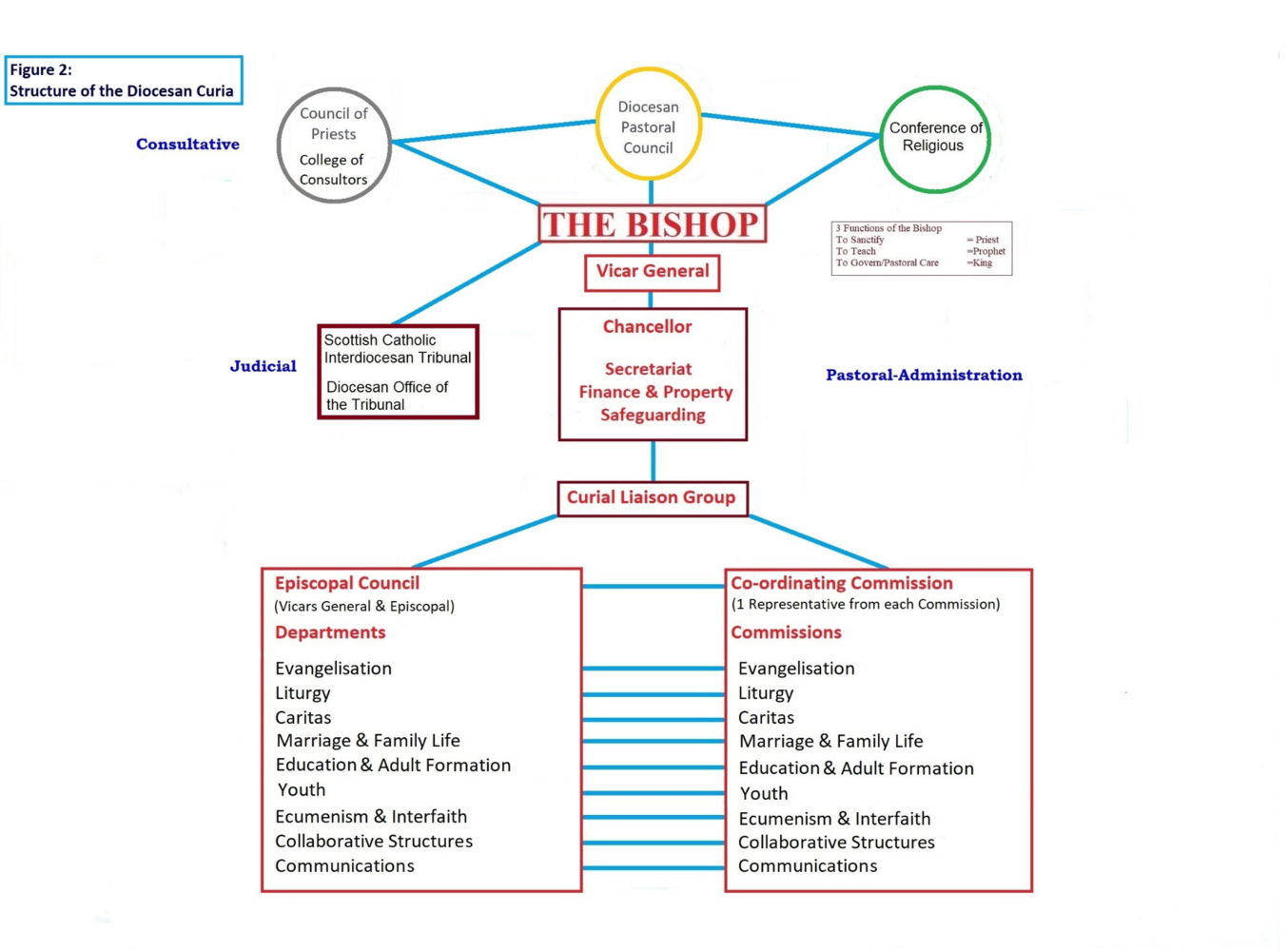
The Church has its own legal system called “Canon Law” and its own judicial system of Tribunals for dealing with various judicial and administrative matters which arise within the Church. In Scotland we have the Scottish Catholic Inter Diocesan Tribunal, based in Glasgow, which fulfils this role for all eight Scottish Dioceses. Clergy and Laypeople from our diocese participate in this work. In particular, the Tribunal deals with cases of marriage annulment and of the dissolution of the bond of marriage.
-
-
-
A diocesan bishop must take care that all the affairs which belong to the administration of the whole diocese are duly coordinated and are ordered to attain more suitably the good of the portion of the people of God entrusted to him. (C. 473 §1)
Where the bishop has judged it expedient, he can establish an episcopal council, consisting of the vicars general and episcopal vicars, to foster pastoral action more suitably. (C. 473 §4)
Each department represented at the Episcopal Council also has a Commission which is represented on the diocesan Co-ordinating Commission
-
-
-
Following the Diocesan Synod in 2016, this commission was established to co-ordinate the work of the synod and to ensure liaison with the appropriate offices of the Diocesan Curia in seeking information or advice, and in reporting the commission’s practical conclusions for the future pastoral governance of the Diocese.
The membership of the Co-ordinating Commission comprises of the Bishop, Moderator of the Synod, a clergy representative from each of the three deaneries, and the Lay Chair of each of the nine Commissions established to provide practical proposals for the pastoral and administrative implementation of the Principles formulated and agree at the Synod and subsequently accepted by the Bishop, as required by canon 466 of the Code of Canon Law.
-
-