-
-
-
Explanation of Terms
-
-
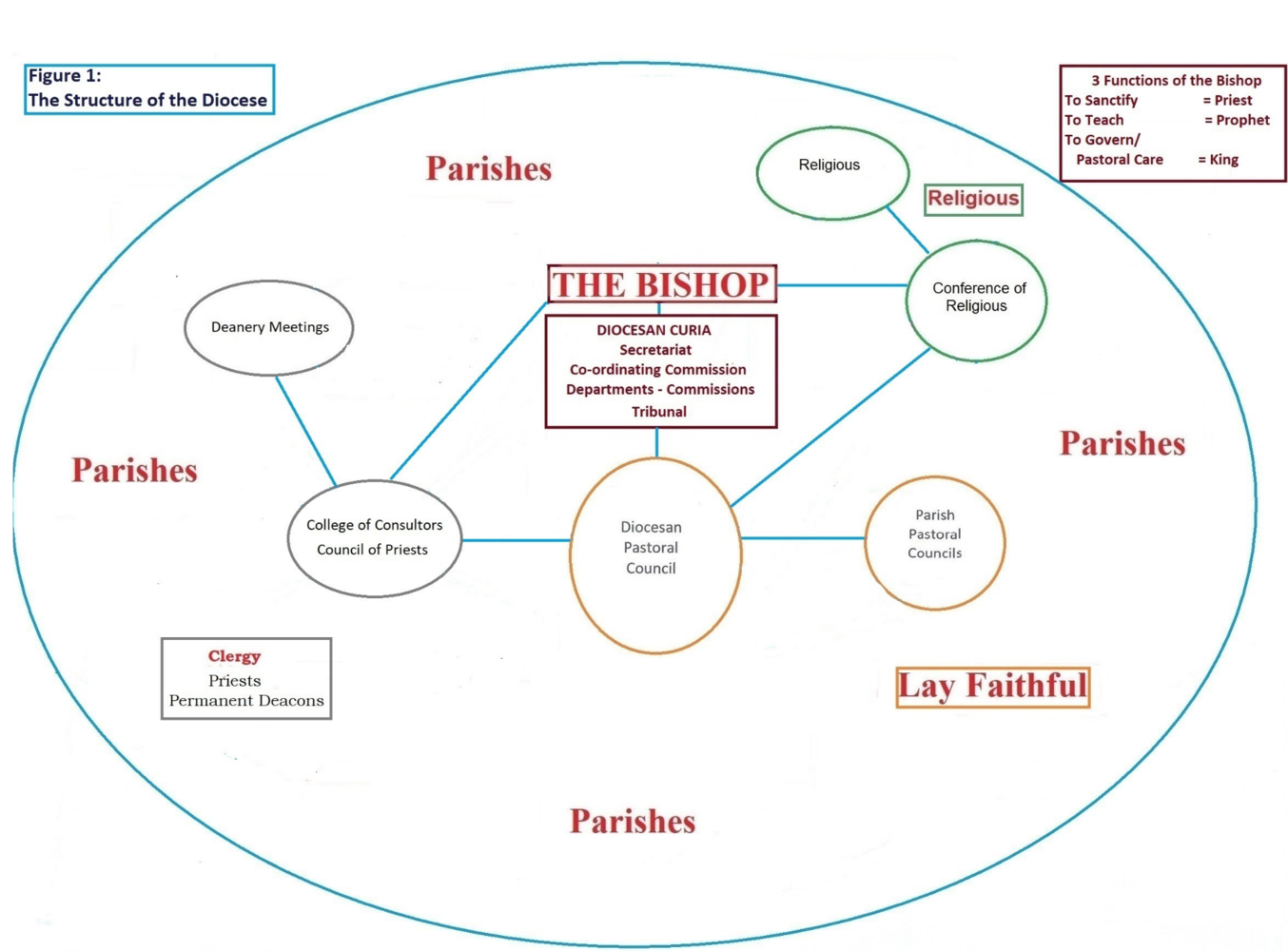
The Council of Priests must be established in each diocese. This is a group of priests which, represents the presbyterium and which is like a Senate of the Bishop. It assists the bishop in the governance of the diocese according to the norm of law to promote as much as possible the pastoral good of the portion of the People of God entrusted to him. (C. 495 §1)
It is the Bishop who convokes the Council of Priests, presides over it, and determines the questions to be treated by it and receives proposals from the members. (C. 500 §1)
The Council of Priests possesses only a consultative vote; the Bishop is to hear it in affairs of greater importance but needs its consent only in cases expressly defined by law. (C. 500 §1)
The Council of Priests cannot act without the Bishop who alone has charge of making public those things which have been established according to the norm of §2. (C. 500 §3)
-
-
-
The College of Consultors is chosen from among the members of the Council of Priests. The Bishop freely appoints some priests (at least six and no more than twelve) who are to constitute for five years a College of Consultors. (C. 502 §1)
-
-
-
The Diocesan Curia consists of those institutions and persons which assist the bishop in the governance of the whole diocese, especially in guiding pastoral action, in caring for the administration of the diocese, and in exercising judicial power. (C. 469)
The Bishop must take care that all the affairs which belong to the administration of the whole diocese are duly coordinated and are ordered to attain more suitably the good of the portion of the people of God entrusted to him. (C. 473 §1)
The Bishop himself coordinates the pastoral action of the Vicar General and Vicars Episcopal. Where it is useful, a Moderator of the Curia can be appointed who must be a priest and who, under the authority of the Bishop, is to coordinate those things which pertain to the treatment of administrative affairs and to take care that the other members of the Curia properly fulfil the office entrusted to them. (C. 473 §2)
The Bishop appoints a Vicar General who is provided with ordinary power and who assists him in the governance of the whole diocese. (C.475 §1)
The Bishop also appoints several Vicars Episcopal, who in specific departments of the Diocesan Curia possess the same ordinary power as the Vicar General. (C. 476)
In every curia a Chancellor is to be appointed whose principal function is to take care that acts of the Curia are gathered, arranged, and safeguarded in the archive of the Curia. (C. 482 §1)
-
-
-
Following on from our Diocesan Synod and after consulting the Council of Priests, Bishop John has decided to re-constitute our Diocesan Pastoral Council (DPC) as the ordinary means of consultation with the lay faithful of the Diocese. Under authority of the Bishop, the DPC studies and weighs those matters which concern the pastoral works in the diocese, and proposes practical conclusions concerning them. (C. 511)
The DPC is composed of members of Christ’s faithful who are in full communion with the Catholic Church: clergy, religious, and especially lay people. Its members are selected in such a way that the DPC truly reflects the entire portion of the people of God which makes up our diocese, taking account of the different areas of the diocese, of social conditions and professions, and of the part played in the apostolate by the members, whether individually or in association with others. (C. 512)
The DPC possesses only a consultative vote. The Bishop convenes it, according to the needs of the apostolate, and presides over it. He alone has the right to make public the matters dealt with by the DPC. (C. 514)
The DPC is to be convened at least once a year, and in our Diocese meets at least twice a year. (C. 514)
-
-
-
A parish is a certain community of the Christian faithful stably constituted in a particular church, whose pastoral care is entrusted to a pastor (parochus) as its proper pastor (pastor) under the authority of the diocesan bishop. (C. 515 §1)
As a general rule a parish is to be territorial, that is, one which includes all the Christian faithful of a certain territory. When it is expedient, however, personal parishes are to be established determined by reason of the rite, language, or nationality of the Christian faithful of some territory, or even for some other reason. (C. 518)
In the Diocese of Paisley there are 33 parishes arranged in three deaneries, according to the local authority areas, i.e. East Renfrewshire, Inverclyde, and Renfrewshire.
-
-
-
After consulting the Council of Priests, Bishop John asked that a (Parish) Pastoral Council be established in each of our parishes The Parish Priest presides the PPC and the Christian faithful, together with those who share in pastoral care by virtue of their office in the parish, assist in fostering pastoral activity. (C. 536 §1)
The PPC possesses a consultative vote only and is governed by the Statutes published by the Bishop. (C. 536 §2)
-
-
-
In the Church there are a great many institutes of consecrated life which have different gifts according to the grace which has been given them: they more closely follow Christ who prays, or announces the kingdom of God, or does good to people, or lives with people in the world, yet who always does the will of the Father. (C. 577)
-
-